Technically, “Art Jam” is a relatively tiny piece of music, a 10-minute-long instrumental passage played on the second and final night of the Great Went. But, as the title signifies, this wasn’t just any jam. This was the Art jam. That phrase has at least two meanings, one literal and one more philosophical:
Literally, it’s the jam the band played while the audience carried pieces of art the band had painted towards a tower of art the audience had painted.
On a deeper level, it’s part of a celebration and, in a sense, a ritual, honoring the ephemeral nature of Phish, of art, and of life itself.
Before we get to Limestone, let’s start in 1966, in the Watts neighborhood of LA. It’s dawn, and the acid from the night before – one of the infamous Acid Tests, this one particularly weird – is still working through everyone on the bus. Members of the Grateful Dead have driven along with the Pranksters to a dead-end street where a cluster of impossible spires rises nearly a hundred feet into the Southern California haze.
These are Simon Rodia’s towers - the life’s work of an Italian immigrant tile mason who, starting in 1921, built them entirely alone with no scaffolding, no machinery, no plans. It’s rebar and chicken wire and cement, encrusted with thirty-three years’ worth of broken glass, seashells, and fragments of 7-Up bottles that kids brought over. The city had condemned this ramshackle monument years before 1966… but they couldn’t pull it down. The towers wouldn’t budge, even with cranes. Earthquakes barely made a dent.
In the documentary “Long Strange Trip”, Jerry Garcia recalls standing there that early morning in 1966, still buzzing. Reflecting on the towers, he says: “If you work by yourself as hard as you can, every day, after you’re dead, you’ve left something behind that they can’t tear down. That’s the payoff. The individual artist’s payoff.”
After a beat, he concludes, “Wow, that’s not it for me. Instead of making something that lasts forever, I think I’d rather have fun. I want to make something flowing and dynamic, not so solid that you couldn’t tear it down.” To create, together, band and audience, in, as Bob Weir calls it, the “exploding moment,” knowing that it can only be this exact way this one night, this one minute. And isn’t that exactly what makes it so special? In other words, perhaps the most sacred part of loving life… is when we let it go.
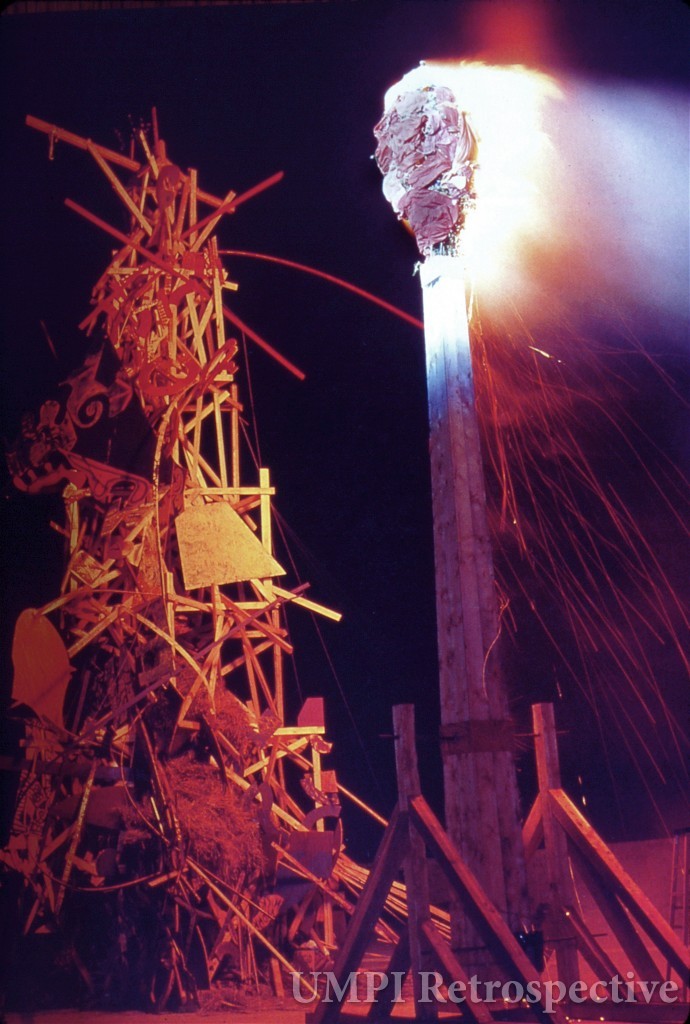
In 1997, two years after Garcia’s death, Phish, along with seventy-five thousand fans, built their own tower together – painted in kaleidoscopic colors, towering above the crowd – and burned it to the ground… on purpose.
Throughout the Went weekend, fans painted plywood panels – no instructions, no curation – that were assembled into a structure several stories tall. It was Rodia’s method inverted: not one man building for thirty-three years, but an entire city of Phish fans building a sculpture in two days.
Then, morphing out from “2001,” with Trey’s delay loops still going, we find ourselves in the “Art Jam.” Trey speaks to the crowd:
"What we've been doing here this weekend is an idea that came out of the fact that when we jam up here, we always feel like there's a mutual energy going on between everybody, the four of us and all of you guys, and something is being created. We don't only feel it, we know it. The whole idea here is to do a mutual piece of art with you guys and us, all built into one thing. It was completely improvisational and was supposed to be the same kind of spirit as the music, which is that we get up here and we don't know what's going to happen and we just go for it."
Then the band's completed paintings were passed through the crowd–hand over hand over hand–carried in a sort of procession across the field to the tower and hoisted into place among the collective fans' work, completing the tower. The band and the audience joined in creation. For about ten minutes, the band improvised a spacious, introspective score for the procession. It’s a hint at the kind of Eno-esque ambient music that would blossom in the coming years. No peaks, no destination. Fish plays a hypnotic percussive wash as Page plays an almost elegiac set of notes on the organ.
Once the band’s pieces were added, the lights went down for "Harry Hood." Trey asked Kuroda to kill everything - "so we can look at the moon and the sculpture." In the darkness, the crowd erupted into the first glowstick war.
And then they burned it down.
Video by phishvideos
As the photos shared by the University of Maine at Presque Isle in their Great Went retrospective of the event show, during the "Tweezer Reprise” encore, a giant matchstick was revealed beside the tower. It ignited, descended, and the entire structure turned into an enormous pyre, with fire illuminating the night sky.
There are accounts of fans being upset that their art was burned. They'd spent hours on their paintings and watched them reduced to ash. But others recognized the burning as the completion of the art, not its destruction.
So that’s the story of how “The Art Jam” played a critical role in a sacred night of Phish history. Maybe Jerry was watching the fiery spectacle on the field that night, standing up on the moon, laughing with his Cheshire cat grin. We can still have fun.

 Phish.net
 The Mockingbird Foundation